Hardwood, Laminate or Vinyl. Choosing Flooring in New Jersey
July 29, 2026Most flooring advice online is written by somebody selling one of the three options. This isn’t that. Hardwood, laminate and luxury vinyl each do something well and each fail in a predictable place, and which one belongs in your house depends far more on the room and the subfloor than on which one photographs better in a showroom. New Jersey adds its own variable, which is a humidity swing that runs the full range every year and moves anything made of wood along with it.
Hardwood: What It Does Well and Where It Fails
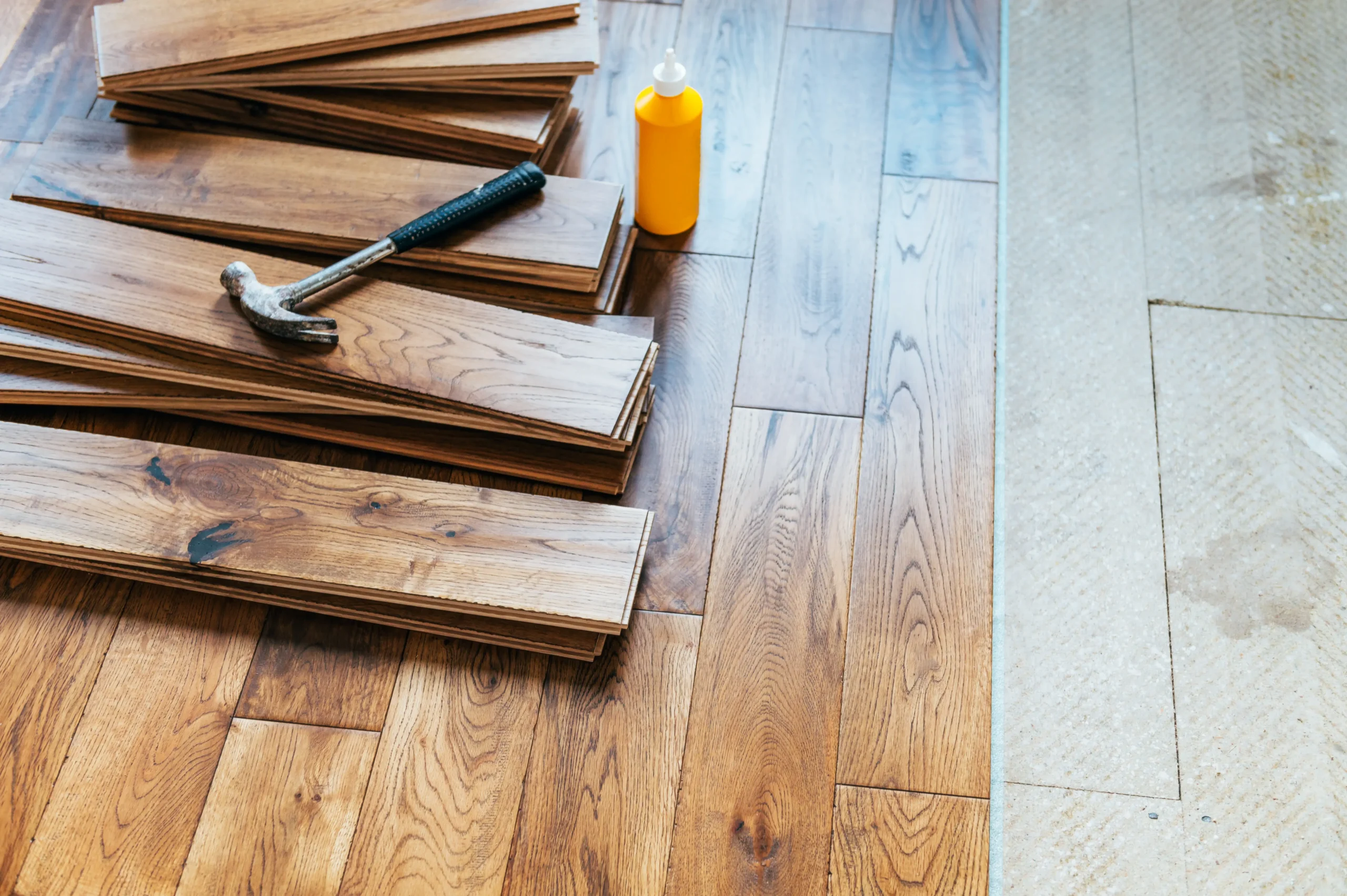
Solid hardwood is the one that lasts longest and the one that tolerates the least. It can be sanded and refinished several times over decades, which nothing else on this list can claim. It also moves with humidity all year, which is why it needs acclimation in the room before installation and expansion gaps at every wall and vertical obstruction. Install it tight in July and it has nowhere to go, and by the following summer you get cupping or buckling that no refinishing fixes.
Engineered hardwood solves part of that. It’s real wood over a dimensionally stable core, so it moves less and handles moisture better than solid does. That opens up installations solid hardwood can’t take, and it’s usually the honest answer where somebody wanted the look of solid wood in a spot that would destroy it.
Laminate: Cheap to Buy, Sensitive to Water
Laminate is a photographic layer over a fiberboard core with a wear surface on top. Modern laminate looks convincing and the wear layer is genuinely tough against scratches, which is why it does well in busy family rooms and hallways. It’s a floating installation, so it doesn’t get fastened down, and that means flatness of the subfloor matters far more than fastening does. A floating floor telegraphs every dip and ridge underneath it, and you’ll feel them before you see them.
The failure mode is water and it’s not subtle. Once moisture gets into that fiberboard core through a seam, the core swells and the plank lifts at the edge permanently. It doesn’t dry back out. That’s why laminate belongs in dry rooms and does not belong in bathrooms, laundry rooms or basements, regardless of what a water resistant rating suggests. Water resistant and waterproof are two different claims, and the difference between them shows up the first time a dishwasher leaks overnight while everybody is asleep.
Luxury Vinyl: The Basement and Bathroom Answer
Luxury vinyl plank has taken over the rooms where wood is a bad idea, and for good reason. The core is not made of wood fiber, so standing water doesn’t swell it. It handles kitchens, bathrooms, laundry rooms and basements, which is exactly where a New Jersey house creates the most moisture risk. It’s also warmer and quieter underfoot than tile, which matters more in a basement than most people expect until they’ve lived with the difference through one New Jersey winter.
It isn’t perfect. Vinyl can dent under concentrated point loads like heavy furniture legs, it can telegraph subfloor imperfections the same way laminate does, and cheaper products can discolor in direct sun. It also can’t be refinished, so when the wear layer goes, the floor gets replaced. For a basement remodeling project or a bathroom in New Jersey that tradeoff is usually easy. For a formal dining room you want to still be there in thirty years, it isn’t the same calculation at all, and hardwood earns its price.
Tile Belongs in This Conversation Too
Tile gets left out of these comparisons because it feels like a different category, but in a bathroom it’s the durable answer and it’s worth considering anywhere water is a factor. It doesn’t swell, it doesn’t dent and it lasts effectively forever when it’s set correctly. The requirement is a substrate that doesn’t flex, because tile set over a subfloor with too much deflection cracks along the joint rather than randomly, and that crack is not repairable in any satisfying way. That makes tile a natural fit for a bathroom remodeling project.
The cost of tile lives in the preparation and the labor rather than the material. Checking deflection, adding underlayment where it’s needed, planning layout so cuts land at the least visible wall and putting movement joints where the specification calls for them all take time. Skipping any of it produces a floor that looks perfect on install day and then cracks in a straight line a year or two later, usually right across the middle of the room where everybody walks.
The Subfloor Decides More Than the Material
Here’s the part that actually determines whether you’re happy in five years. Almost every flooring complaint traces back to what was underneath. Cupping, gapping, lifting seams, cracked tile, hollow spots and squeaks are symptoms of a subfloor that wasn’t level, wasn’t dry or wasn’t stiff enough. Correcting a subfloor takes a day and it happens once. Replacing a failed floor means the entire job over again, plus moving all the furniture out and living through the disruption a second time for no additional benefit.
Over a concrete slab, moisture testing is the step nobody wants to pay for and the one that protects everything else. Concrete releases moisture for a long time, and a slab reading high will destroy a wood floor installed on top of it. Most manufacturers void the warranty outright when no reading was taken. The test takes very little time, the reading gets recorded, and it’s the whole difference between a warranty claim that gets honored later and one that quietly doesn’t. Professional flooring installation treats that reading as the starting point, not an afterthought.
Key Takeaways
- Solid hardwood lasts longest and tolerates moisture least, so it needs acclimation and gaps.
- Engineered wood is usually the honest answer where somebody wanted solid below grade.
- Laminate swells permanently once water reaches the core, so keep it in dry rooms.
- Luxury vinyl is the practical answer for New Jersey basements, baths and laundry rooms.
- The subfloor causes most flooring failures, and slab moisture testing protects the warranty.
Not sure which one belongs in your room? Send us the dimensions and what’s underneath it now, and get a written estimate that prices the preparation separately.
Frequently Asked Questions
How do I get started on my project?
Reach out for a free estimate. We visit your property, take measurements and send a written, itemized estimate with no obligation.
Are you licensed and insured?
Yes. G.A.P Evolution Construction holds New Jersey license 13VH12802200 and carries insurance on every project.
Do you handle every trade in house?
Yes. The same licensed crew handles remodeling, electrical, plumbing, flooring, carpentry and painting, so you never coordinate separate contractors.